

Justice Minister launches pilot programme for electronic monitoring of prisoners
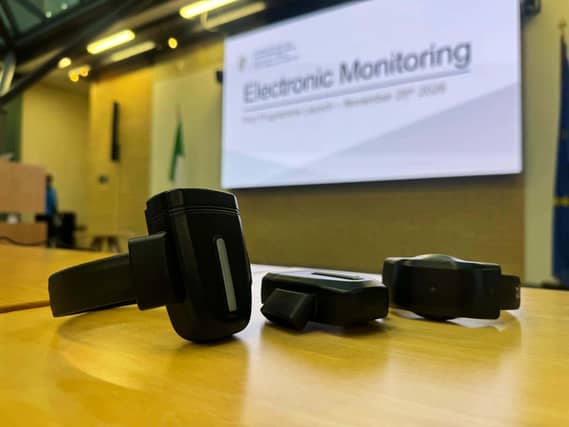

The programme could see 30 to 50 electronic tags used in the first year to monitor between 90 and 150 prisoners on temporary release.
Some prisoners could be given temporary release with a location monitor under a pilot launched today by the Justice Minister.
Jim O’Callaghan launched the Electronic Monitoring Pilot Project in Dublin on Wednesday, which could see 30 to 50 electronic tags used in the first year to monitor between 90 and 150 prisoners on temporary release.
Mr O’Callaghan said the monitors will not be available for serious offenders and only people who are going to be granted temporary release.
He said that in the new year it may be rolled out to people on bail, but that it “expressly excluded sex offenders”.
“You have to take into account the type of offence, their behaviour in prison, the extent to which they will be rehabilitated back into society,” he said.
“So that whole temporary release scheme is designed not to cover violent offenders.

“In terms of the project that we’re going to extend it in the new year, that’ll be in respect of people who are making applications for bail, it may be a situation where somebody will be granted bail by the court if it is the case that they are agreeable to have an electronic monitoring device on them, because we’ll be able to ensure that they comply with the terms of the bail.”
The 12-month pilot phase will be implemented on a phased basis from Wednesday, allowing for processes and procedures to be tested before any wider scale rollout.
The Irish Prison Service reported that prison occupancy in Ireland is at 115%.
Mr O’Callaghan said the idea of the electronic monitors is to take the strain off the prison system.
“It is not a replacement for custody, but it may assist in freeing up prison capacity in some cases,” he said.
“There are a lot of people in prison because there’s a concern that they may not comply with terms of order setting them, so, like if you if you have a curfew order on you, you won’t be able to avoid it if you’re wearing one of these.”
Director General of the Irish Prison Service, Caron McCaffrey, disagreed with Mr O’Callaghan that the pilot would help with the number of prisoners, however, she said that if the programme is rolled out long term, it could reduce the number of people on prison beds awaiting a trial or sentencing.

“The main response to overcrowding is the prison building programme that’s currently ongoing, in the last couple of years, we’ve brought on stream over 300 spaces,” she said.
“From the pilot’s perspective, we’re not seeing this as a mechanism to reduce the prison population.
“Today, about 19% of people in custody are on remand, and if we look at the annualised figures, almost 40% of people who come to custody every year come in on remand, and so there is potential to reduce the number of people who are taking up beds in prison on remand, and to make those beds available for the sentenced population.”
Ms McCaffrey is responsible for setting the parameters for who could be eligible for the monitors.
She said previously that people who were serving eight years were eligible for parole, but with new legislation brought in in 2019, it now only applies to people serving 12 years or more.
“I’ve delegated sanctions for people serving sentences for less than eight years, but public safety will be our primary consideration, and that will be done on an individual, case-by-case basis.
“So, there is a cohort of people serving between eight years and 12 years that we are potentially looking at. But what we will be excluding are crimes where there are significant victim issues,” she said.
She added that if a prisoner is given temporary release with a monitor, the prison service can put conditions on their release to help with reintegration.
“Temporary release is a really important structure for us to release people safely,” she said.
“So, if we leave it till the end of somebody’s custodial sentence, we can’t put conditions in place. So, attending addiction treatment, attending education, reporting to the guards. So by using temporary release, we can make sure people are scaffolded and structured in terms of their release into the community.”
Budget 2026 saw a 2.1 million euro allocation for the programme, with an additional 1.5 million euro in 2027 to support the managed service contract along with other operational and associated project costs.
Allied Universal Electronic Monitoring (AUEM) was awarded the contract for managing the electronic monitoring service after a public procurement process.
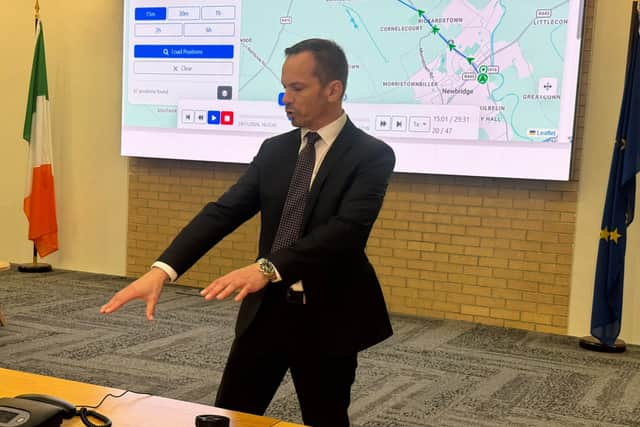
An account and business development manager for the company, Matt Prevett, said that monitoring operatives will be able to track the individual wearing the tag on an app that shows their travel path in green when they are in permitted zones and red when they enter areas restricted to them.
An alert would then be sent to the prison system.
“If they’ve gone into an exclusion zone, the point will change from green to red. So that would be an infringement of their conditions,” he said.
“So that alert would then appear within our monitoring centre and be dealt with in accordance with the reaction plan.”
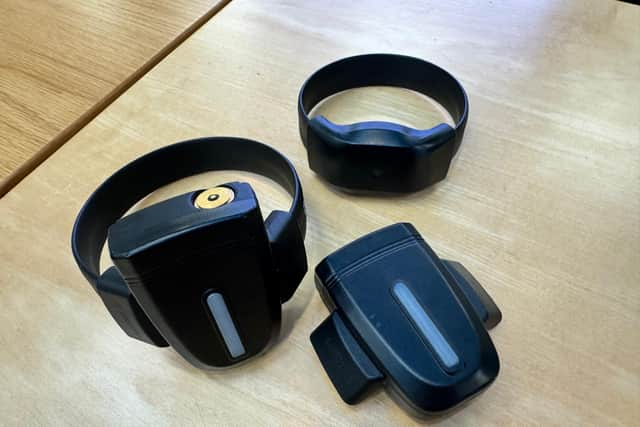
He added that the monitors are composed of two devices around the individuals’ ankle, a GPS tag and a radio frequency tag.
A home monitoring unit will also be fitted in the curfew location and will be used as a method to be able to contact the individual.
He said the devices are designed to alert the system if an attempt is made to tamper with them.
“All of the devices are highly secure, so the data is encrypted in terms of the communications, with built-in tampers accordingly around the strap,” he said.
“So, if the strap is interfered with in any way, it will send out an immediate alert. There are also tampers for interfering with the case, trying to shield it, blocking the communications as well.
“That’s the same on the radio frequency tag. In terms of the home monitoring unit, this also has built-in tampers as well. So, once it’s been installed securely, any attempts to move it, tilt it, will be met with an alarm and an alert.
“If they try to break into it or move it in any way, it will send out alerts. All of the alerts will go into our monitoring centre for an immediate response.”
A dedicated Electronic Monitoring Unit has been established within the Department of Justice, Home Affairs and Migration, which will be responsible for ensuring compliance with contractual obligations, monitoring performance against key indicators and co-ordinating the operation of the pilot across the justice sector.