

Donegal man hanged in historic murder case was the victim of a miscarriage of justice - New evidence suggests
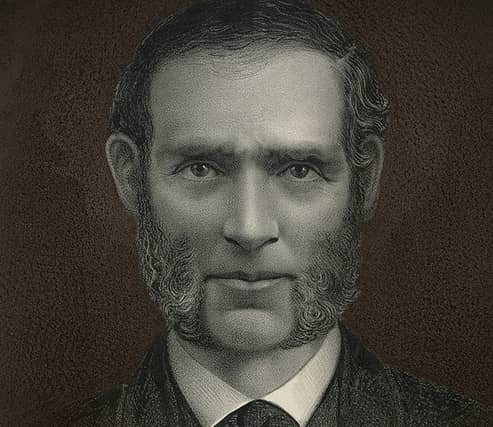

Fascinating new book ‘The Queen v Patrick O’Donnell’ by Seán Ó Cuirreáin and TG4 drama-documentary
A fascinating new book published today suggests that a Donegal man, Patrick O'Donnell from Gweedore who was hanged in a high-profile murder case in London in 1883 may have been the victim of a miscarriage of justice.
This is, according to former journalist and broadcaster, Seán Ó Cuirreáin as a result of newly discovered evidence from an archive file closed to public scrutiny for over 100 years.
He says that the evidence from a British Home Office file suggests that an Old Bailey judge, Mr Justice Denman, who heard the case against Patrick O’Donnell accused of the murder of the Invincibles leader James Carey, withheld crucial information in court which indicated that the jury believed that the killing was ‘without malice aforethought’.
A killing ‘without malice’ would equate to manslaughter and would have been punishable then by a short prison sentence rather the mandatory sentence of hanging which arose in cases of murder ‘with malice aforethought’.
Mr Justice Denman presided at the trial of Patrick O’Donnell (45), a labourer with no formal education, charged with the murder of James Carey, who led the Invincibles, the group responsible for the Phoenix Park murders in which two of the most senior political figures in the country, Thomas Burke and Lord Cavendish, were viciously stabbed to death in May 1882. In order to avoid conviction Carey turned informer and gave evidence against his colleagues, five of whom were hanged in 1883.
A newly published book ‘The Queen v Patrick O’Donnell’ and a TG4 drama-documentary of the same name, reveals for the first-time evidence found by author Seán Ó Cuirreáin which suggests that Mr Justice Denman misled the court, including the defence and prosecution teams as well as the press, when he amended and misrepresented the wording of a direct question from the jury which showed they were inclined to believe the killing was ‘without malice’.
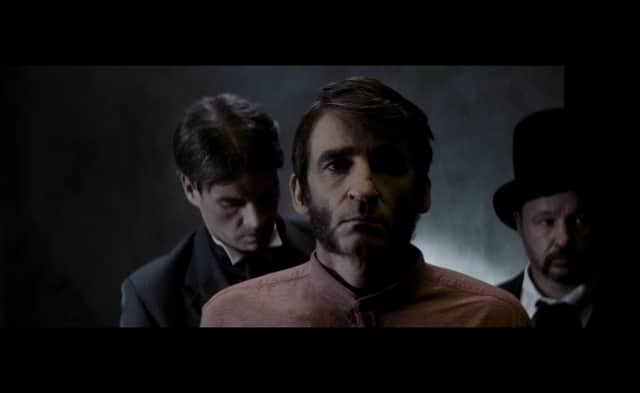
Photo: Gweedore actor Eoghan Mac Giolla Bhríde as Patrick O'Donnell being prepaired for hanging
However, the actual question posed by the jury which was not read to the court is included in a file on the O’Donnell case in the British National Archive which was ordered to be ‘Closed until 1985’. The handwritten note of the jury’s question in blue pencil was attached by Mr Justice Denman to 61 pages of meticulous notes made by him during the course of the two-day trial in a document which was subsequent ordered to be closed to public scrutiny until 1985.
The question suggests that the jury had no problem in understanding the concept of ‘malice aforethought’ but rather sought to ascertain if they reached a verdict of ‘murder without malice aforethought’ would the judge accept that verdict. The text of the question was: “If we find prisoner guilty of murder without malice aforethought can you take that verdict”.
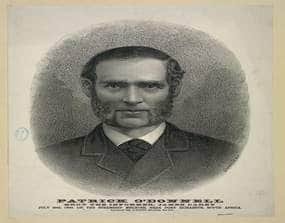
Photo: Patrick O'Donnell
Ó Cuirreáin noted as ‘significant’ that no reference was made to the jury’s question in the official transcript of the trial.
All of the newspaper reports on the trial refer only to the judge’s amended question as reporters were unaware of true nature of the jury’s query.
An earlier question posed by the jury was read in full to the court by Mr Justice Denman and his response to it attracted criticism from the defence team who said it favoured the prosecution case and was biased against Mr O’Donnell. This too was omitted from the official trial transcript.
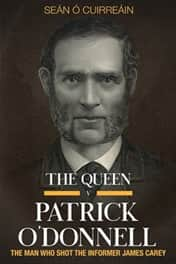
The new book by Seán Ó Cuirreáin
He had abandoned America and was travelling to South Africa where he hoped to make his fortune in the diamond mines there when he unknowingly befriended Carey during the three-week sea voyage from London to Cape Town as the informer and his family attempted to flee into hiding under an assumed name.
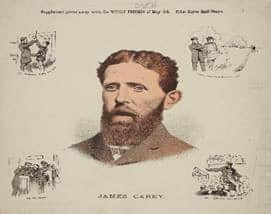
Photo: James Carey of the Invincibles
An ‘O’Donnell Defence Fund’ established in America accumulated $55,000 (c. €1.5 million now) to employ a high-powered legal team to defend him.
Since O’Donnell had been granted American citizenship during his years there, the US President pleaded that the sentence of death be postponed pending efforts to mount an appeal.
The iconic French writer Victor Hugo also took up his case and contacted Queen Victoria directly with an urgent request to spare the Donegal man’s life. Such appeals were rejected and O’Donnell was hanged at Newgate Prison on 17th December 1883. His death secured his immediate status as a national hero at home and abroad and he was celebrated as an Irishman who had died for Ireland.
Two large Celtic crosses were erected to commemorate him, one in Glasnevin Cemetery in Dublin, the second in his native Gweedore, where a public event in his honour is still celebrated annually.
Seán Ó Cuirreáin is a former journalist and broadcaster. He served as deputy head of RTÉ Raidió na Gaeltachta prior to being appointed as Ireland’s first Language Commissioner. His book Éagóir [Injustice] on the Maamtrasna Murders and the subsequent drama-documentary Murdair Mhám Trasna (TG4, 2018) contributed to the process which led to the posthumous presidential pardon for Maolra Seoighe/ Myles Joyce who was wrongly convicted and hanged for those murders. He was appointed a member of the Council of State by President Michael D. Higgins in April 2019.
Published by Four Courts Press
Paperback. 192 Pages. Ills. €17.95
ISBN: 978-1-84682-994-9