

Johnny Gogan: The filmmaker who found a home in Leitrim

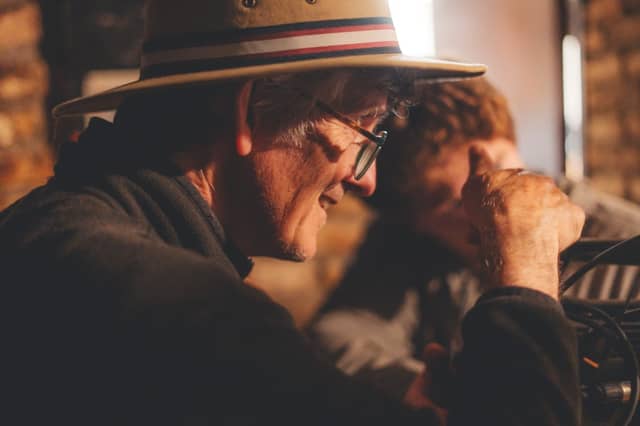

From a teenage school projectionist to an award-winning filmmaker, Johnny Gogan reflects on four decades in Irish film and why he chose to build his life and career in Leitrim.
Johnny Gogan’s first job in film came when he was 16 years old. He was a student at Newtown School in Waterford and, long before he would become a filmmaker, director and producer himself, he was the boy responsible for showing the films. “My first taste of film was actually when I was at school,” he says. “I used to be the projectionist.”
His family were living in Laois at the time and Johnny travelled around 40 miles to the Quaker school in Waterford. There was little then to suggest that film would eventually become his life, or that his career would take him from the independent cinema scene in Dublin to making films from Manorhamilton in north Leitrim. After leaving school, Johnny moved to Dublin and completed a degree in history and politics.
By the mid-1980s, however, he was becoming increasingly involved in film. He worked with his sister running the Ha’penny Film Club in Dublin, at a time when independent and alternative cinema was developing a new audience in the city.
From there came Filmbase, which became an important resource centre for Irish filmmakers, and in 1987 Johnny established Film Ireland magazine for the organisation. “That was my first kind of solo run in film,” he says.
The magazine would survive for another 30 years before moving online, while Johnny himself was beginning to move from writing about films to making them. “I started making films at that point.” His first film won Best Short Film at Galway in 1990.
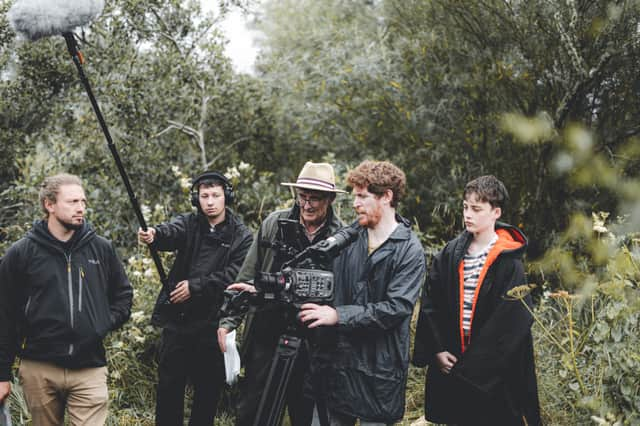
“It was a great start.” He followed it with feature films including Bargain Shop and The Last Bus Home, establishing himself as a filmmaker in Dublin.
But by the late 1990s, Johnny was becoming interested in another part of Ireland and another kind of story. He wanted to make a film about the Border.
The idea became Mapmaker, a film set in the uneasy period following the ceasefires, when the violence had stopped but decades of division and suspicion had not simply disappeared with it. That project brought Johnny Gogan to Leitrim. More than 25 years later, he is still here. “I’m sitting in the room where we edited it here in The Glens Centre,” he says, speaking from Manorhamilton. Mapmaker was made in 2001 and by then something unexpected had happened. Johnny had come west to make a film and discovered that he did not particularly want to go back.
“By that stage, I decided I really liked living in Leitrim and decided to stay,” he says. “I’d kind of had enough of Dublin anyway. I’d lived whatever life I was going to live in Dublin.”
What appealed to him was not only the landscape or the possibility of making films somewhere different. It was the chance to become part of a community.
“It was great to find somewhere where I could really be part of the community, because there’s such a strong sense of community here.”
There was, of course, a professional trade-off.
Building a career in film from rural Leitrim was more difficult than doing it from a city, particularly in an Irish industry heavily concentrated around Dublin. Johnny nevertheless found a way to make it work. “I was able to make films from here — a little bit more difficult probably than if I was in a big city.”
During the 2000s, documentary became an increasingly important part of his work, while he continued developing feature films. Among them was Black Ice, the second of what Johnny describes as his Border films following Mapmaker.
More than a decade after it was made, Black Ice continues to find an audience and was picked up by Disney earlier this year. For Johnny, however, the film also demonstrated something which would become increasingly important throughout his career: the amount of creative talent already present in the north-west.
“There’s a huge number of people from the filmmaking community in the region who worked on the film,” he says. It changed the way he thought about making work from Leitrim. “You don’t have to look out over the horizon for the talent. There’s often this talent right in front of you.” Some of those working relationships have lasted for years.
Johnny points to editor Patrick O’Rourke and musician Steve Wickham, who has scored a number of his films, among the people he has repeatedly collaborated with. Gradually, the filmmaker who had arrived in Leitrim to make one production became embedded in the creative life of the county. And not only through film.
Johnny became involved in local politics, helping Gareth McDaid and Martin Redding establish the local Green Party organisation in 2003. He has also been involved in Irish-language activities and other community projects.
That ability to move between different worlds is one of the things he particularly values about rural life. “In a city, you tend to be known: this is what you do, you’re a filmmaker,” he says. In the countryside, he believes, those distinctions are less rigid. The local postman might also train an underage GAA team and be involved in amateur drama. People are not necessarily defined by their occupation.
“I like that variety,” Johnny says. “Living here affords having that kind of varied life.” He believes rural communities can also expose people to a much wider cross-section of society than city life sometimes allows. “Ironically, when you live in a rural area, you get to know all sorts of people.
“Whereas if you live in the city, you tend to only know people who are in your similar class and cultural or professional field.” After more than two decades in Leitrim, Johnny is now as interested in creating opportunities for other filmmakers as he is in his own productions. And that is where his own career and the wider story of filmmaking in the north-west begin to meet. Because the industry Johnny entered in Dublin in the 1980s has changed enormously — but one problem, he believes, has proved much more difficult to shift. Irish filmmaking remains heavily centralised. It is something he is now actively trying to change.