

Wind farms: Opportunities or overreach? The debate facing Leitrim


Leitrim Focus investigation marks a new regular feature taking a deeper look at issues affecting daily life in Leitrim, with this week’s focus on wind farms.
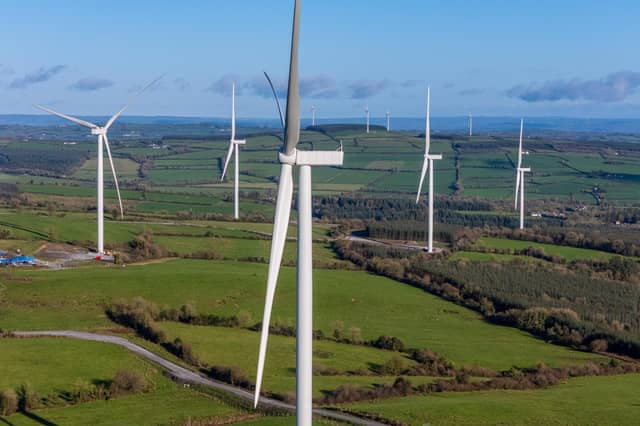
The Save Dough Mountain Group is leading a campaign to challenge plans by FuturEnergy Ireland, a joint venture between Coillte and the ESB, to erect 14 wind turbines, each around 180 metres high, at Dough Mountain near Manorhamilton.
At a public meeting in Manorhamilton last week, locals voiced concerns about how the proposed project could affect the structure, ecology and heritage of the mountain.
Some locals raised concerns about constant noise and shadow flicker from an existing wind farm in the area, which they said had affected their quality of life.
This is the latest chapter in a long fight against wind farms in the area. In 2021, the group Wind Aware Dromahair successfully stopped a proposed project by the same company to build ten 170-metre-tall wind turbines in the county.
The common refrain throughout the event was that locals were not opposed to wind farms in principle, but rather that this particular project, which would see structures taller than the Statue of Liberty erected in north Leitrim, was unsuitable.
North Leitrim currently hosts seven wind farms, including those at Altagowlan, Black Banks, Corrie Mountain, Garvagh, Knockaneden, Moneenatieve and Tullynamoyle.
The county is a strong contributor to Ireland’s electricity supply, producing around 100MW of electricity from wind energy. The Lissinagroagh Wind Farm project would double that output if it becomes a reality.
Nationally, there are more than 340 active wind farms in Ireland, providing around 5GW of electricity to the grid, according to Wind Energy Ireland (WEI), the trade organisation for the Irish wind energy sector.
That figure will need to increase to 8GW, with a further 5GW of offshore wind energy also required if Ireland is to meet its target of sourcing 80% of its electricity from renewable energy by 2030.
To that end, Ireland has 16 wind farms currently under construction, representing 553MW of generating capacity, while a further 78 projects, totalling 3,241MW, have planning permission.
Obtaining planning permission does not guarantee that a project will be built, though it is a major hurdle.
In reality, many of those projects will never be completed because they will fail to secure a connection to Ireland’s ageing power grid, a government contract, or funding.
Public support for wind farms remains high in Ireland, even among those living in close proximity to them, according to the Sustainable Energy Authority of Ireland (SEAI).
Electricity prices drop significantly during windy periods. However, when the wind blows in one part of the country, it often blows elsewhere too, and the electricity grid is unable to handle all of the resulting output from wind farms.
Until the grid is upgraded, around 12% of the wind energy that could be produced is lost, according to WEI.
A common question is: why can’t they just build at sea, out of sight and out of mind?
The short answer is that it is more complicated. Aside from the greater cost of building at sea, the planning process for marine construction was completely overhauled in 2021 and remains largely uncharted territory.
Moreover, until 2021, offshore projects were unable to access government support schemes for wind energy developments. That has now changed, and offshore development is likely to accelerate.
These projects are being pursued as cost-competitive means of producing renewable energy and improving energy independence. Ireland remains one of the EU countries most reliant on fossil fuel imports for electricity, meaning prices are highly sensitive to market shocks, such as Russia’s invasion of Ukraine and the conflict between Iran and the United States.
READ NEXT: Exclusive: Manorhamilton mother fears homelessness after being asked to leave rented home
Under new legislation, wind farm projects above 50MW, such as the Lissinagroagh Wind Farm, are considered Strategic Infrastructure Developments and are submitted directly to An Bord Pleanála.
An associated application submitted by FuturEnergy Ireland to An Bord Pleanála includes the construction of a grid connection from north Leitrim to Sligo and a 110kV substation, which would facilitate electricity generated by the project and by future developments in north Leitrim.
Applications for projects of this scale cost companies hundreds of thousands of euros to prepare and can run to thousands of pages, making them expensive to produce and difficult for local people to engage with.
“It’s probably a little bit too complicated, and we should try to find ways of simplifying and making the planning system more accessible.
“But, on the other hand, there does need to be a certain level of complexity because what you’re essentially asking the board to do is approve an application to put up a machine,” said Justin Moran, spokesperson for WEI.
“It should be about listening to people in the area and trying to find a way to meet them halfway.”
This time around, Save Dough Mountain, the main group opposing the development, has raised thousands of euro to hire experts to help lodge an objection to the application. Objections must be submitted to An Bord Pleanála by July 10.
FuturEnergy Ireland was contacted for comment and referred the Observer to Wind Energy Ireland.