

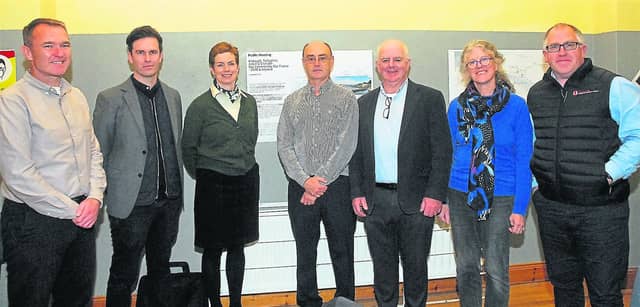

A major community-led integrated social, economic and spatial strategic plan outlining the potential for positive development in Kinlough, Tullaghan, Askill and Glenade was launched in Kinlough Community Centre on Tuesday, September 27.
Local needs are aligned with regional and national policies to produce short, medium and long-term recommendations.
Potential partners, supports and funding are identified in respect of each recommendation.
Special advisory committee, back, from left, Mícheál McGinty, Laurence Lord, Sheila Brennan, Liam Freeburn, Ann Gallagher and John Campbell. Front, from left, Cllr Justin Warnock, Miriam Delaney, Oonagh Kavanagh and Ian Dempsey. Picture: Willie Donnellan
Background
The study area comprised of the Electoral Divisions of Kinlough (population 1,032), Tullaghan, (699), Gubacreeney (736), Aghalateeve (223) and Aghavoghill/Melvin (211), with a total aggregate study area population of 2,901 (2016 National Census).
The population in Kinlough has increased rapidly in the past 20 years, having more than trebled from the 2002 population level of 335 persons, to the current (2016) figure of 1,032.
In order to understand the community’s priorities, the consultants designed a three-week period of community engagement in April and May 2022 which consisted of an in-depth survey, targeted phone calls and an in-person community workshop.
There were 247 responses to the survey equivalent to a third of all households in the study area. The survey asked respondents for their opinions on the current social, economic and physical / environmental situation in the study area, and also asked for their views on what is most needed for the future.
Louise Collins, Marie Rogers, Sheila Brennan, Padraic McGowan and Molly Finn, all from Tullaghan pictured at the launch of the Kinlough, Tullaghan, Askill & Glenade social, economic and spatial strategic plan in Kinlough Community Centre on Tuesday, September 27. Picture: Willie Donnellan
However, there was a significant shift in this positive outlook when young people were asked if they can see themselves staying in the study area, 73% of respondents under 25 said they did not think they would remain, with most citing lack of employment opportunities and housing as their reasons.
Older respondents also raised concerns about lack of healthcare and services for older people.
Quality of life concerns dominated the respondents' priorities, with requests for better active travel; pedestrian and cycling links; and better-quality housing (including estates to be taken in charge by the Local Authority); employment opportunities; high-speed broadband and community amenities.
There was vocal support for protecting the high-quality natural environment, with concerns expressed for over-development and frustration at threats to the environment including the dominance mono-cultural Sitka-spruce forestry.
Lough Melvin and the Eco Park at Kinlough
Potential for greater connectivity
In the report, strategies for regional planning include taking greater advantage from the Wild Atlantic Way, introducing regionally coordinated visitor information and way-finding, transport infrastructure as well as cross-border initiatives aligned with the ICBAN regional priorities.
Making better use of the N15 National Primary Route using the infrastructure as an economic driver (the proposed site zoned for enterprise in Tullaghan will be well placed for connectivity to Sligo and Donegal), better connectivity with Donegal – upgrading Lennox Bridge on the Drowes river, to develop a cycle track between Bundoran and Kinlough.
Fr John Phair P.P., Louise Collins, Marie Rogers, Cllr Justin Warnock, Jackie Warnock and Sheila Brennan
Wild Atlantic Way
Failte Ireland’s Wild Atlantic Way is Ireland’s first defined touring route, and has generated notable successes in generating visibility, tourism and economic benefits along the route from Donegal to Cork.
Yet, the Tullaghan area has not benefitted from this as there is no ‘Discovery Point’ in Leitrim and the Leitrim coastline is not represented in Wild Atlantic Way (WAW) literature.
The 2021 Part 8 process for coastline access at Tullaghan is a significant positive development in addressing the lack of visibility of North Leitrim.
Joe Kavanagh and Noel McGowan, Kinlough Development Association
Wayfinding
The report recommends the development of a multi-phased visitor Wayfinding strategy to facilitate pedestrian, cyclist and vehicular movement in the study area, a graphically clear multi-lingual physical and digital signposting strategy is required to encourage visitors to venture off the primary national roads and into the study area.
The primary critical location for physical signage is on the N15 route at Tullaghan, this should be supplemented by signage at Kinlough village, in the Arroo mountains and at entry points to the study area close to Glenade and Askill.
Lough Melvin
Lough Melvin offers potential for greater amenity use by locals and visitors; lake access is hampered by limited access points, inadequate signage and lack of infrastructure and facilities. The report recommends greater access to the lake, while being mindful that the environmental protection of the lake must take precedence over its amenity usage.
Jackie Warnock, Padraic McGloin and Bernardine Connolly at the launch of the plan.
Kinlough
The strategy for Kinlough aims to improve connection to Lough Melvin and to the existing Eco-Park and to upgrade the public realm to provide a strong focus on biodiversity as well as improved experience for people visiting and living in Kinlough.
Improving the main street through traffic calming, a shared surface between the two churches and increased planting will make the centre of Kinlough a more vibrant and attractive place.
Housing and town centre living are also a key area of potential improvement. We propose that an audit is carried out to explore the potential to re-purpose vacant buildings for community use.
Tullaghan
Development of Tullaghan village
Askill
Investigate the ownership of Derrynaseer Pier and work towards Leitrim County Council taking the pier in charge, to secure long term access and allow for the necessary upgrades.
Daniel McCullagh reading the details of the plan.
Glenade/Arroo
Glenade includes areas of striking natural beauty and environmental significance including the Dartry Mountain range, Glenade Lake and Eagle’s Rock. The Glenade Resource Centre is located at the former Aghanlish National School building, which forms the trail head for the Arroo Trail.
Glenade has the potential to be the base for a larger network of walking trails and bothies. The Glenade Resource centre could facilitate way-finding, toilet and shower facilities, and picnic areas.
The development of the centre as a destination hub for tourism is essential.
1.
Mícheál McGinty, Laurence Lord and Miriam Delaney, AP+E consultants, John Campbell, Cllr Justin Warnock, Oonagh Kavanagh and Liam Freeburn
2.
Cllr Padraig Fallon, Cllr Mary Bohan, Phil and Pat McGeever and James Gallagher at the launch in Kinlough. Pictures: Willie Donnellan