

Spanish Armada sails again - Historic galleon graces horizon at Streedagh Beach

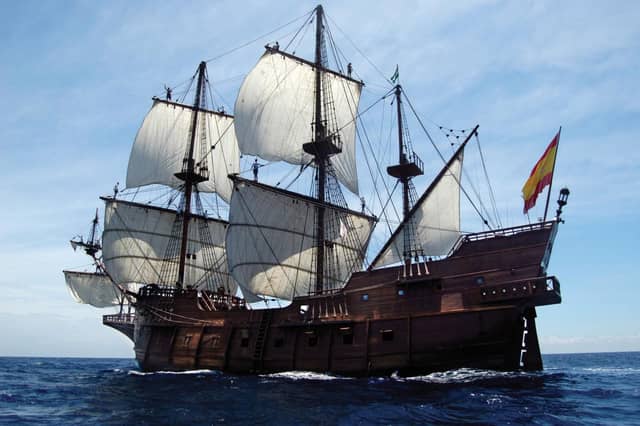

Watching El Galeón Andalucía sail off Streedagh
All day on June 30, nobody seemed quite sure where she was.
The arrival times kept changing. One report suggested she was delayed with bad weather. Another said she was still making her way south of Donegal. Along Streedagh Beach, people scanned the horizon, phones in hand, wondering if they’d see one of the most extraordinary sights ever to grace the Sligo coast.Then it appeared.
A dark silhouette emerged from the Atlantic, growing larger with every passing minute until the Galeón Andalucía came into full view.
Beautiful.
Majestic.
History in motion.
Within seconds, people were running across the sand towards the shoreline, eager to get a little closer. All eyes fixed on the towering vessel gliding silently through the bay.
Dark timber hull, towering masts and billowing sails, she looked as though she had sailed straight out of 1588.
Cars pulled up parking roughly on the beach. Doors flew open determined not to miss the moment. For a few magical minutes, Streedagh seemed to slip backwards through time.
The world's largest replica Spanish galleon sailed the very same coastline where three ships of the Spanish Armada — La Lavia, La Juliana and Santa María de Visión — were wrecked during the Great Gale of 1588. More than 1,100 sailors and soldiers perished just offshore, making Streedagh one of Ireland's most poignant historical landmarks.
Before continuing to Sligo Harbour, the galleon paused off the beach for a wreath-laying ceremony and fired an eight-cannon salute in honour of those who never made it home.
Standing on the shore, it was impossible not to wonder what this coastline looked like more than four centuries ago. The sea was calm this time. The sky was bright. Yet the sight of the great wooden ship against the Atlantic horizon brought the past startlingly close.

Captain Miguel Cuesta Almansa said it was "a huge honour" to sail the same waters as the Spanish sailors who made the journey almost 500 years ago.
"It is a huge honour to be able to sail in these same waters as Spanish sailors did nearly 500 years ago now," he said.
"It is such an honour to experience this and already to be receiving such a welcome. We are so happy to get all this recognition and that we stayed so much in the memory of the people of Sligo and along the west coast."
The 55-metre Galeón Andalucía, built as a faithful replica of the Spanish galleons that connected Spain with the Americas and Asia for more than three centuries, is now berthed on Deepwater Quay in Sligo. Constructed from iroko and pine using traditional shipbuilding techniques, the vessel has sailed hundreds of thousands of nautical miles, visiting ports including London, New York, Shanghai, Singapore and Quebec as a floating ambassador for Andalusian maritime history.
The ship is open to the public from July 1 to July 12, giving visitors the rare opportunity to walk her six decks, explore life aboard a 17th-century galleon and discover the remarkable story of the ships that once crossed the world's oceans.
Self-guided tours run daily from 10am to 8pm at Deepwater Quay. Online tickets cost €12 for adults, €6 for children aged five to 10, while a family ticket (two adults and up to three children) costs €30. Tickets purchased at the quayside are slightly higher. Children under five go free when accompanied by an adult.
For those of us standing on Streedagh beach, however, the most unforgettable part was the rare privilege of watching history sail past once again.