

Tailoring against the tide of fast fashion

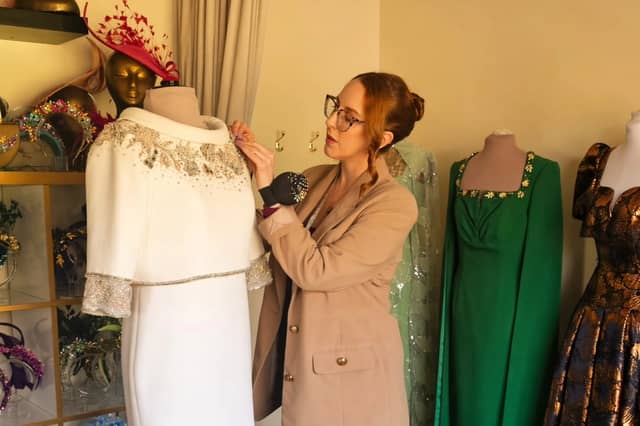

Leitrim designer Joanne McGowan on the craft of creating timeless fashion in a fast-fashion world
The Leitrim Rose will take to the Rose of Tralee stage this month in a bespoke gown created by Leitrim designer Joanne McGowan.
Inside a quiet studio near the picturesque village of Jamestown, just outside Carrick-on-Shannon, Joanne has spent more than 40 hours bringing the bespoke dress to life. There are no production lines here, no factory machines churning out identical garments. Just one woman, metres of luxurious fabric, a mannequin, pins scattered across a workbench and decades of skill turning an idea into something completely unique.
In an age where fashion is increasingly disposable and clothes are produced by the million, Joanne belongs to a shrinking generation of craftspeople creating garments entirely by hand. One stitch at a time. "I draft every pattern from scratch based on the person's measurements," she says. "Everything is done from start to finish by hand." It's a world away from the fashion industry most of us know.
Today, clothing has never been cheaper or faster to produce. Trends appear overnight, wardrobes change with the seasons and garments are often worn only a handful of times before disappearing to the back of a wardrobe or into a charity bag.
Joanne works at an entirely different pace. Every seam is considered. Every fabric is chosen for a reason. Every fitting changes the garment a little more until it feels like it belongs to the person wearing it. That's why women travel from across Ireland — even from Donegal — to her Leitrim studio for multiple fittings. They're not buying a dress. They're commissioning one.
For Joanne, that's simply what bespoke means.
Every garment begins with a conversation, a blank sheet of paper and a set of measurements. There are no standard patterns, no shortcuts and no compromises.
"I draft patterns based on their measurements," she explains. "Everything is done from start to finish by hand."
It's a slower way of working in a world obsessed with speed. Fashion has never moved faster. New collections appear almost weekly, clothes are ordered with the click of a button and many garments are worn once before being forgotten. Yet inside Joanne's studio time moves differently. Here, craftsmanship still matters.
The Leitrim designer has quietly built a reputation as one of the country's few bespoke dressmakers, with clients travelling from all over Ireland in search of something they simply can't find on a shop rail. Some arrive with folders full of inspiration photographs, others with little more than an occasion in mind.
"Sometimes people come with nothing," she laughs. "They'll just say, 'I don't know what I want. I don't know what suits me.' Most people will bring a couple of photos and that gives me an idea of their style. Then I can usually fly with something from there and come up with something unique that suits their shape and their personality."
That personal approach is exactly what drew Catherine Cullen to Joanne's studio. The Leitrim Rose had tried on several dresses before slipping into one Joanne had originally designed for herself.
"I make something new for myself every time I go to a wedding," Joanne says. "I have a small collection of higher-end dresses. Catherine tried on a good few and that one was just stunning on her, so I made a hat to match it."
Creating the Rose of Tralee stage gown has become one of the highlights of Joanne's career. She previously designed the stage dress for the Leitrim Rose two years ago, and admits there is something magical about watching months of work come to life beneath the bright lights of live television. "It's lovely seeing your dress come to life on stage and on TV," she says.
The journey to becoming a full-time designer began long before race meetings and national television. Growing up, Joanne was happiest in the art room or the home economics classroom. "I loved sewing, especially in school," she recalls. "I loved art and home economics. When the sewing machines came out they were the things I loved."
In her early twenties she bought her first sewing machine and began teaching herself to make simple dresses from commercial patterns. Alterations followed, then commissions. Slowly the hobby became a business.
"It kind of evolved into bespoke occasion wear. Initially it was just a hobby, then it was part-time. The busier I got, the more I was doing it. I gave up working and went full-time. I've been full-time now for over ten years."
Ask Joanne what keeps her motivated after all those years and she doesn't mention television appearances or fashion competitions.
Instead, she talks about the final fitting. "It's how it makes people feel," she says. "The last fittings are the best. You see their face when they come out. Seeing how happy it makes someone is probably the most satisfying part."
She believes the secret isn't expensive fabric or designer labels. It's fit. "Nobody is a shop size," she says. "I don't think I've ever measured anyone who fitted a shop size. When something is made it is so much more flattering. People don't realise how good they can look in clothes if they're fitting them right. The fit is what makes it."
That philosophy perhaps explains why women are willing to drive for hours to her quiet Leitrim studio.
Word of mouth remains her biggest advertisement. Facebook has brought new customers, but recommendations from previous clients continue to fuel the business. One woman regularly travels from the very north of Donegal, making several journeys for fittings before collecting her finished outfit.
"People will travel to get something made and get something different," Joanne says.
Alongside dresses, Joanne has become equally well known for her millinery. This summer alone, her hats have appeared across racecourses around the country. Sometimes clients arrive with old hats they no longer love.
"I had a girl going to Sligo Ladies Day. She brought me a red hat and I've completely changed it. It's black and gold now. The difference is amazing. She couldn't believe the transformation."
Her inspiration comes from everywhere. Instagram has become a daily source of ideas, while Irish and Australian race meetings provide endless examples of daring style. She particularly admires couture designers Elie Saab and Galia Lahav, whose elaborate gowns continue to inspire her own work.
"They're amazing," she says. "They're kind of the ones I'm always looking at and wishing I could do dresses that extravagant."
Despite working in fashion, Joanne has mixed feelings about the industry itself. She understands why people buy inexpensive clothes, but worries about the culture of wearing garments once before discarding them.
"I shop in Penneys myself," she says. "But I have stuff that's years old. If it's ripped I'll fix it or tweak it. I reuse all of my scraps for hats and I try to throw away as little as possible." She believes practical sewing skills are becoming increasingly rare.
"I think there should be more classes where people can learn to upcycle," she says. "But you do need a huge amount of patience. It doesn't suit everyone."
That patience is evident throughout her studio. Fabric arrives from Germany, Belfast, mainland Britain and Asia, where she often finds unusual textiles unavailable elsewhere. The Rose dress itself features a fabric she sourced specially because of its distinctive texture and beadwork.
"It just looked so different," she says. "It was beautiful." For all the glamour associated with race days and the Rose of Tralee, Joanne's working life is surprisingly peaceful. She spends her days in her Jamestown studio accompanied not by television, but by audiobooks.
"I'm addicted to audiobooks," she laughs. "You get completely absorbed in the work." Working from home suits both her personality and her craft. "I love it. I don't have to commute. I've no traffic issues. Everyone says the studio has a lovely atmosphere. It's very relaxing."
Soon, the studio will fall quiet again. Catherine's gown will leave its mannequin and take centre stage beneath the bright lights of the Rose of Tralee. Most viewers will admire the finished dress for only a few fleeting moments. Few will ever think about the dozens of hours hidden inside every seam, or the Leitrim woman who quietly stitched them there.