

'We all knew who did this': Paul Williams recalls the day Ireland lost Veronica Guerin


Thirty years on, Paul Williams says the trauma of Veronica Guerin's murder has never left him.
Thirty years after the murder of journalist Veronica Guerin sent shockwaves through Ireland, veteran crime reporter Paul Williams still struggles to speak about the day his friend was gunned down.
Even now, three decades later, the memories remain painfully vivid.
"It was probably one of the most traumatic moments of my entire 60 years on this planet," Williams said.
"It's very hard to describe seeing a dead body, but seeing the body of your colleague and friend who had just been shot... I still get a chill down my spine every time I think about it."
Veronica Guerin, a fearless crime correspondent with the Sunday Independent, was just 37 years old when she was murdered on June 26, 1996, after exposing Ireland's most dangerous drug gangs. She was shot six times while stopped at traffic lights on Dublin's Naas Road in broad daylight, leaving behind her husband Graham and six-year-old son, Cahill.
Williams had worked alongside Guerin throughout the rise of organised crime in Ireland and said the events of that day are impossible to forget.
Williams said he knew immediately who was responsible. "I just turned to the guards and said, 'We all know who did this,'" he recalled. Moments later, the shock overwhelmed him. "That's when I started throwing up on the road."
He had little doubt who was responsible. "John Traynor had told me less than a year earlier, after John Gilligan had assaulted Veronica, that Gilligan would kill her. The moment I saw her, I remembered those words."
The emotional weight of that day came flooding back recently when Williams was honoured with the inaugural Veronica Guerin Award for Outstanding Contribution to Journalism. The surprise presentation left one of Ireland's most recognisable crime journalists momentarily speechless.
"It was kept a complete secret," he recalled. "When they opened the award and I saw my picture beside Veronica's, a tsunami of emotion came over me. For the first time in my life, I couldn't speak."
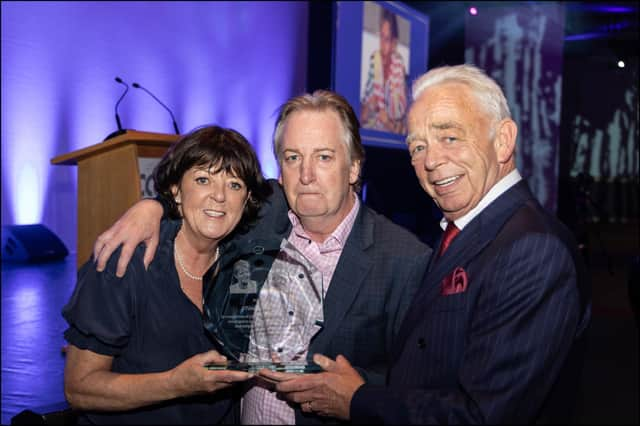
The week of commemorations, interviews and podcasts marking the anniversary reopened wounds that, he admits, have never fully healed. "It was bringing it all back again. It was hugely emotional."
Yet Williams believes Guerin's murder fundamentally changed Ireland forever. Far from intimidating journalists into silence, it united the country against organised crime.
"We were all determined," he said. "The whole country was galvanised. The public, the media, the judiciary, the Gardaí — everybody came together. Even criminals started coming forward with information."
He describes it as "our finest hour." The public outrage forced the State to act, leading to landmark legislation that transformed how organised crime is investigated and prosecuted.
"People talk about Veronica's legacy," he said. "Her legacy is that the State finally got the weapons it needed to fight organised crime."
Those powers have continued to expand over the decades, particularly following the murder of businessman Roy Collins in 2009, allowing Gardaí to prosecute membership of criminal organisations, use surveillance evidence and bring gang leaders before the Special Criminal Court.
"None of that would have happened without Veronica's murder," Williams said.
"It takes an unprecedented tragedy to force the State to take action."
Although gangland crime has grown into a multi-billion euro industry, Williams believes the authorities would be in a far weaker position today had Guerin never exposed the underworld.
Williams himself became a target after her death.
For more than a decade, Gardaí maintained around-the-clock protection at his home, while he spent over two years with armed bodyguards.
"I didn't ask for it," he said.
"They imposed it."
He believes the State had learned the devastating lessons of Guerin's murder.
"They told me the threats were serious. They had wanted Veronica to keep full-time protection, but she didn't want it."
Looking back, Williams says crime reporting in Ireland was entering completely uncharted territory during the mid-1990s.
"Nobody expected this to happen," he said.
"Even though Veronica had been beaten up and threatened, nobody believed they would actually murder a journalist."
Sadly, Guerin would not be the last.
Five years later, Williams lost another close friend when Northern Ireland journalist Martin O'Hagan was murdered by loyalist paramilitaries.
"From then on," he reflected, "it wasn't just business anymore. It became personal."
Thirty years on, the pain remains.
Recently reunited with Guerin's husband Graham, their son Cahill and members of the family during the anniversary commemorations, Williams said seeing Cahill as an adult brought home everything that had been lost.
"He was six years old when his mammy died," Williams said.
"He turned out to be a fine young man — confident, articulate. It was lovely to meet him again."
For Williams, Veronica Guerin's greatest legacy extends far beyond journalism.
It lives on in every organised crime investigation, every gang prosecution and every law introduced to confront criminal networks that once believed they were untouchable.
But for those who knew her best, she will always be remembered simply as a friend whose courage changed Ireland forever.