

Beyond the pitch: GAA highlights demographic challenges facing Leitrim

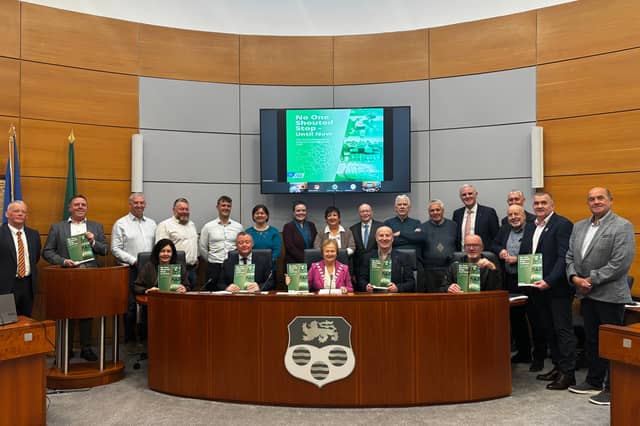

Leitrim’s GAA clubs face growing challenges from rural depopulation, with the National Demographics Committee calling for partnership to protect local communities.
The continued depopulation of rural Ireland has brought significant demographic changes, with consequences for schools, local services, housing and sporting clubs. Leitrim has been particularly affected, with its population falling more than that of any other county since 1926.
Despite these challenges, the GAA remains a major part of life in Leitrim, with its influence extending far beyond sport to form an important part of the social fabric of communities throughout the county.
However, rural decline is also affecting the organisation, a reality highlighted by the GAA’s National Demographics Committee at November’s meeting of Leitrim County Council, where it presented its report, No One Shouted Stop – Until Now.
Speaking to the Leitrim Observer, Benny Hurl, chairperson of the committee, said Ireland had undergone a significant shift in population, with two out of three people now living in urban Ireland, compared with one in three 50 years ago.
He said the resulting depopulation of rural Ireland had created regional, economic, medical, educational and infrastructure imbalances, with knock-on effects for jobs, employment and the economy.
Despite these challenges, Mr Hurl praised Leitrim’s GAA clubs for their continued commitment to their communities.
“Leitrim is a very proud county. Despite the reduction in population, the fire and the passion burns brightly in every club,” he said.
He also highlighted Leitrim County Council’s ‘Most Definitely Leitrim’ campaign, which aims to bring the diaspora home to local communities, saying the GAA hopes to assist with that process.
“We want to be a partner to work together to make things better for the communities in Leitrim for the economy, jobs and infrastructure and most importantly for the clubs and communities they serve,” he said.
Dr Peter Horgan, GAA Strategy, Insights and Innovation Manager, said the committee had been working on the issue for almost three years, adding that demographic challenges in Gaelic games had existed for 60 to 70 years.
In his presentation to the Council, Dr Horgan outlined the impact of demographic change on communities and GAA clubs, highlighting both Leitrim’s high participation rates and the challenges facing clubs as population patterns change. The committee hopes to work with the Council to identify ways of responding to these challenges.
He explained how rural decline affects local amenities, including shops, pubs and post offices, while falling numbers of children in primary schools, limited housing development and the amalgamation of previously separate teams can further threaten the sustainability of rural communities.
The merging of teams can also mean the loss of a distinct local identity, as communities face increasing difficulties sustaining their own clubs and teams.
However, Dr Horgan described Leitrim as a “wonder”, highlighting the county’s potential for strong participation in Gaelic games despite its small population.
He told the meeting that 78 per cent of boys aged between six and 11 in Leitrim were members of a GAA club, compared with approximately one in three across the island of Ireland.
According to the presentation, Leitrim has 23 GAA clubs, 17 LGFA clubs and two camogie clubs. The figures highlight the county’s ability to recruit young players, although concerns remain about the long-term sustainability of clubs as population patterns change.
The demographic challenges facing clubs are not confined to rural areas. Urban centres are experiencing their own pressures as populations grow and club membership increases.
As county towns, including Carrick-on-Shannon, experience population growth, clubs can face rising costs in providing facilities, pressure on playing space and difficulties ensuring children receive sufficient game time.
“The playing numbers might be high but the overall penetration is quite low. There’s a huge mix and imbalance faced by GAA clubs and communities,” said Dr Horgan.
Imbalance was a recurring theme throughout the presentation, referring both to the uneven distribution of Ireland’s population and to the different challenges facing GAA clubs depending on where they are located.
Dr Horgan highlighted that one in three people live in Dublin or within one hour of Dublin in satellite towns, while only 18 per cent of GAA clubs are located in this area. He also noted that 25.5 per cent of all children aged between zero and five in Ireland are concentrated across just 50 clubs.
These figures illustrate how population growth and the distribution of young children can leave some clubs with access to large numbers of potential players, while others face difficulties sustaining teams in areas with smaller populations.
Dr Horgan said the GAA believed there was an opportunity to establish a working partnership with local authorities to address these geographic challenges.
“We think we have an opportunity here to establish a working partnership,” he said. “We bring community presence, social connection and cultural identity,” adding that the Council brings expertise in infrastructure, planning and sustainability.
He said the aim was to ensure that population change, housing development and sporting facilities were considered together when planning for the long-term sustainability of communities.
Members of Leitrim County Council were supportive of the concept of working together, a response welcomed by the GAA National Demographics Committee.
Cllr Enda Stenson, a committee member and former Leitrim GAA County Board chairman, whom Dr Horgan described as being “at the forefront of putting a voice for rural Ireland,” called the presentation a “momentous day for Leitrim.”
“Leitrim can often be left in the background but not today,” he said, adding that it was reassuring to know the committee would be there to help with whatever was possible from a demographic perspective.
Cllr Gary Prior, chairman of County Junior Championship-winning Aughnasheelin GAA club, said the challenges around player numbers were being discussed at clubs throughout the county, citing his own club as an example, where five clubs had to combine to form two teams for an under-11 blitz.
“In ten years we’re really worried about where we’ll be at. We have the facilities we once dreamed of but numbers are the problem,” he said.
Speaking to the Leitrim Observer, Mr Hurl said the report’s title was deliberate, referring to John Healy’s 1968 book The Death of an Irish Town, which was retitled No One Shouted Stop.
He said the committee wanted to work with communities to address the demographic challenges facing Ireland, while taking a positive approach to the future.
“Leitrim is a very small county and the only way is up as far as we're concerned,” he said.
The report is available to view at https://www.gaa.ie/article/gaa-s-national-demographics-committee-report-launched