

Family pray beside Liam Farrell’s exhumed body before it is taken for forensic analysis


Remains taken to Dublin for CT scan as gardaí step up probe into 2020 death
The remains of retired Leitrim farmer Liam Farrell were exhumed on Friday morning in a major new development in the long-running investigation into his death, as gardaí renewed their appeal for information and vowed to continue efforts to establish exactly what happened.
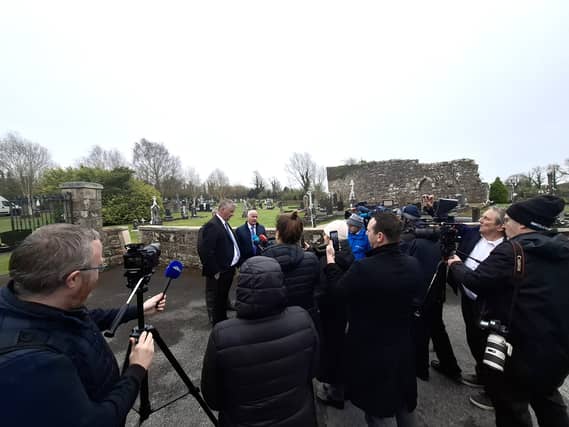
The operation took place at Cloonmorris Cemetery on Friday, April 10, where members of Mr Farrell’s family gathered from early morning as investigators began the sensitive process.
The exhumation began at approximately 8am and lasted a little over two hours, with several official agencies present throughout. Members of the Garda Technical Bureau attended the scene, assisted by funeral professionals, while Chief State Pathologist Professor Linda Mulligan was also present, alongside a senior environmental health officer from the HSE.
The Bornacoola Parish priest also attended the graveyard, where special exhumation prayers were said with Mr Farrell’s family.
Later, the remains of the 87-year-old were transported to the Mater Hospital, where a CT scan is due to be carried out before being transferred to the Office of the State Pathologist for further forensic examination.
For the Farrell family, Friday marked another painful chapter in their six-year search for answers.
As the remains were removed from the grave, relatives stood together in prayer beside a waiting ambulance. Some briefly spoke to media, while others comforted one another during what was described as a deeply moving and dignified scene.
Friday’s exhumation was carried out following an order granted by Justice Minister Jim O’Callaghan and is being viewed as one of the most significant investigative steps taken in the case to date.
At the 2024 inquest, evidence was heard that the original scene raised immediate concerns. Mr Farrell was found with visible injuries, including bruising to his face and eye area, while further marks were noted on his hands, knees and feet. Items of clothing were scattered near the back door, with his shoes and socks removed, and blood was reported at a number of locations around the property.
The 2024 inquest also heard that the original pathologist, Professor Paul Hartel, had not been told the scene was being treated as potentially suspicious when he carried out the first post-mortem. He said he had not been given access to scene photographs at the time, while later evidence suggested some of the injuries could potentially have been consistent with blunt force trauma or an assault.
Chief Superintendent Des McTiernan said the latest move is aimed at progressing the investigation through modern forensic analysis.
“The exhumation process is an attempt to progress the case forensically in order to get clarity on the circumstances surrounding the death of Liam Farrell on January 12, 2020,” he said.
He added that all procedures had been followed throughout the operation.
“All necessary protocols governing an exhumation process have been implemented and will continue to remain in force until the exhumation concludes.”
Mr McTiernan also made a fresh public appeal for assistance, stressing that even small details from that night could prove important.
“Liam Farrell was a very popular member of the Rooskey community. His family has deep ties there,” he said.
“Despite his 87 years, Liam Farrell was a fit man at 6ft 2in tall.”
The senior Garda also repeated details of what Mr Farrell was wearing on the night he was last seen.
“On the night of January 11, 2020, he was wearing a dark suit, with a light blue shirt and dark wine-coloured tie.”
Investigators are continuing to focus on Mr Farrell’s final known movements.
Gardaí say he left his home at Aughamore shortly before 9pm on Saturday, January 11, 2020, and made the 10-minute walk to Reynolds Pub in Rooskey, where he met and socialised with local people.
At around 10.30pm, he left Reynolds Pub and went next door to the Weir Lodge, where he continued socialising.
Gardaí have said he had drinks there with a very close friend.
At approximately 12.15am in the early hours of January 12, he left the Weir Lodge, crossed the road towards the riverside and began the short walk home.
At around 3.30pm later that day, he was discovered unresponsive to the rear of his house by his son and daughter.
Mr McTiernan said investigators are particularly anxious to speak with anyone who may have been in either premises that night or who may have seen Mr Farrell as he made his way home.
“Again, I am appealing to anyone who was socialising in Reynolds Pub or the Weir Lodge on the night of January 11, 2020, and recall seeing Liam Farrell there,” he said.
“Similarly, I am appealing to anyone who may have seen Liam Farrell leave the Weir Lodge in the early hours of January 12, 2020, cross the road to the riverside and walk home.”
He said gardaí remain determined to establish a full picture of the events surrounding the case.
“I am in particular appealing to any person who may have any information regarding the case to come forward and assist in our efforts to get clarity on the events of January 12, 2020, and the subsequent discovery of Liam Farrell by his son and daughter.”