
'We have a rule of law in this country' - Army deployed across Ireland amid fuel protests
Search


09 Apr 2026

Please allow ads as they help fund our trusted local news content.
Kindly add us to your ad blocker whitelist.
If you want further access to Ireland's best local journalism, consider contributing and/or subscribing to our free daily Newsletter .
Support our mission and join our community now.
To continue reading this article, you can subscribe for as little as €0.50 per week which will also give you access to all of our premium content and archived articles!
Alternatively, you can pay €0.50 per article, capped at €1 per day.
Thank you for supporting Ireland's best local journalism!


“I've been anxiously waiting for this day,” says Emanuel Covaso, who recalls being transfixed the first time he used a computer, a Pentium 486, that his father brought him in the early 1990s as a child in Romania.
“I couldn't wait for the day when I would be able to communicate with a machine in my natural language,” said Emanuel, who is now based in Leitrim.
The idea of interacting seamlessly with an intelligent and adaptable machine was a fantasy he shared with many other tech enthusiasts; however, now that increasingly intelligent AI is becoming integrated into daily life, that dream is becoming a reality.
It has become common for those who build AI assistants to use OpenClaw, a free and open-source autonomous AI agent that can be installed on a computer and execute tasks given via message.
OpenClaw is used as a base, and from there, a more complex and tailored assistant can be built upon by the user.
“When we first had OpenAI release the interface to communicate with artificial intelligence. That's the moment when I set out to build my own software development company,” said Emanuel.
“Now I have it sitting on my laptop, and I have one assistant that can spawn its own software engineer, coders, designers, researchers, so on and so forth,“ he says.
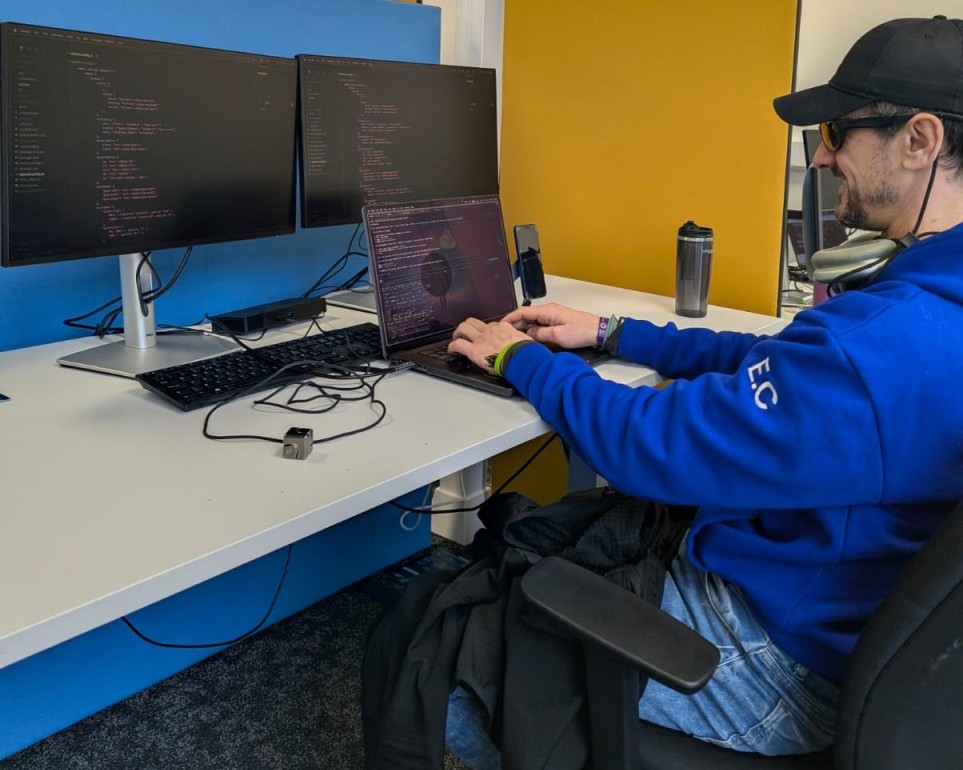
Emanuel, a computer networks and cyber security student at ATU Sligo, is on a mission to develop an AI assistant to help students with learning difficulties, which he intends to release to the general public.
The AI, Emmi, runs on his computer and has control of a range of tools, integrated with a number of different AI software developed for specific tasks, but can work broadly from generating a Word document, creating PDFs, to running research online or building a web application.
“It can control my machine. I can literally tell it to open Word and doc or something, and it just fires off, and it works on my computer, and I can see it open the tabs or whatever it's doing. I'm aiming at full assistant mode, and it's been working.”
As someone who grew up neurodivergent and dyslexic with difficulty reading, Emanuel has developed Emmi to help him with those challenges.
“This, for me, is a lifesaver because what used to take me two, three hours to read, maybe a research document and kind of try to extract points from it, now I can have it done in literally minutes.”
Though more than that, he is trying to develop software that is individual to him, that knows him, his story and uses that information to match him on how he likes to work.
He took his CV, made recommendations, and wrote stories about himself and his life to give to the software so it could learn about him and tailor itself to him.
The AI itself is constantly running on the device and learning how to complete tasks more effectively, with Emanuel himself guiding changes where needed.
This notion of using AI as a learning tool is something he believes in and is working towards with his startup, NeuroBridge, which records what a lecturer says in a class, and automatically creates and sends notes to students that are tailored to their specific needs, allowing them to sit back and focus completely during the lesson.
He envisions releasing his model online for free use, but with an interface and a questionnaire that would allow it to be adapted to whoever is using it, depending on their needs.
He is satisfied with where the project is so far, but stresses that there are problems yet to be solved, like ensuring the cybersecurity elements are strong enough in the AI.
Despite being an enthusiast when it comes to AI, he feels that people will always be needed for quality control and overview, but he does see a future where a lot of jobs are done with AI, which he feels will be positive.
“I might be wrong, but I don't think someone set out as a child to grow up and become a person that sits on a computer and writes reports for someone else, right?”
READ NEXT: Awesome Mayo brush aside outclassed Leitrim in Dalata Hotels Connacht U20 FC
A techno-optimist, Emanuel believes this will ultimately be a good thing and free people up to focus on solving social problems and pursuing creative endeavours.
However, he does see the need for education on the use of AI to guard against its overuse.
“As humans, we want everything to be simple, to be easy, to have a good life, but if we start relying on technology too much, then how are we going to contribute to the future of humanity? If we are reliant on a piece of technology to do everything for us.”
“I don't think that the technology, the artificial intelligence technology itself, will be the thing that makes us rely on it as much as we need to understand that it is our choice.”

Subscribe or register today to discover more from DonegalLive.ie
Buy the e-paper of the Donegal Democrat, Donegal People's Press, Donegal Post and Inish Times here for instant access to Donegal's premier news titles.
Keep up with the latest news from Donegal with our daily newsletter featuring the most important stories of the day delivered to your inbox every evening at 5pm.

This publication supports the work of the Press Council of Ireland and Office of the Press Ombudsman, and our staff operate within the Code of Practice of the Press Council. You can obtain a copy of the Code, or contact the Council, at www.presscouncil.ie, Lo-call 1800 208 080 or email: info@presscouncil.ie.