

Trinity Books and The Reading Room: Can the physical book survive AI?


Two Carrick bookshops, one rapidly changing world
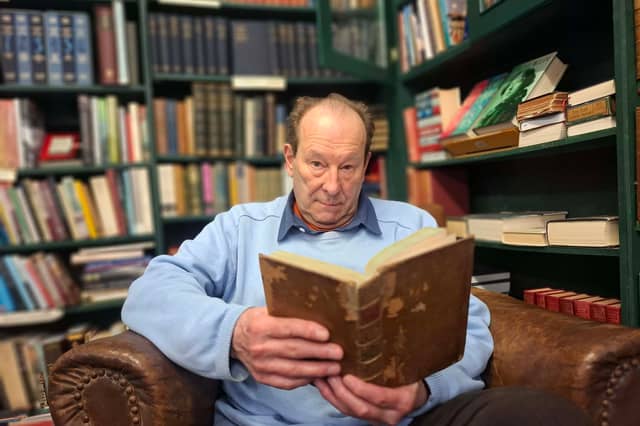
For more than 25 years, Nick Kaszuk has surrounded himself with books at Trinity Books in Carrick-on-Shannon. He opened the shop around 1999, initially filling just one corner with books before the collection gradually expanded.
Today, rare and unusual editions travel from his Carrick shop around the world, including a €1,000 Raymond Chandler first edition bought by Martin Scorsese’s production company. “There’s always going to be a lot of people who love books more than files,” Nick said.
A lifelong collector, Nick had been living in London before eventually settling in Ireland with his wife. When they arrived during the Celtic Tiger years, he admits they were not entirely sure what they were going to do. “I’ve always liked books. I was a big collector,” he said.
“When we came here, my wife and I didn’t really know what to do. It was the middle of the Celtic Tiger and it was booming.
“I just stumbled across this. Not that room, just this room. And I thought, books, why not?” At the time, the rent was around €50 a week and Nick also secured an enterprise grant to help him get started. “When I started, I had books just in that corner. Nothing else,” he recalled. “People didn’t really know what to make of it.”
The books kept coming. Eventually he expanded into the adjoining premises, knocking through a wall into what had previously been a small art gallery. The internet, which might once have appeared to pose a threat to independent bookshops, has instead allowed Trinity Books to find customers around the world.
Nick sells specialist and collectible books online through AbeBooks, with around 500 individually photographed books listed at any one time. “I don’t bother with something like there’s already 50 copies there and they’re cheap,” he explained. “I look for things where there’s only about five copies and they’re expensive.”
His customers can be anywhere. A two-volume set of Lady Gregory’s journals was recently being prepared for a buyer in Toronto, while one student travelled all the way from Spain to Carrick-on-Shannon because Trinity Books had a book he needed for his thesis.
“He hopped on a Ryanair flight, came and got it,” Nick said. Perhaps his most famous customer, however, came via Hollywood. Last Christmas, Nick received an online order for a first edition by Raymond Chandler, priced at €1,000. The address caught his attention.
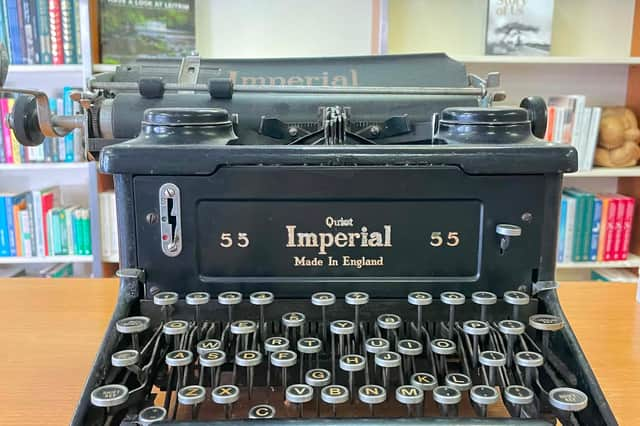
“It was to a production company, so I thought that was strange,” he said. Nick searched the company online and discovered it was Martin Scorsese’s production company. The book had been ordered by a member of the filmmaker’s research team.
“That’s the good thing about it,” Nick said of selling online. “When it’s not busy, the internet keeps me going.” Over the years, Trinity Books has also attracted its share of famous faces. Bob Geldof once wandered through the door and ended up talking to Nick about their shared connection to Canada and travels in Kashmir.
But it is often the books themselves that have the more remarkable stories. Nick showed the Leitrim Observer how something as small as a number printed on a copyright page can transform the value of a book. “The number one must be present,” he explained, pointing to the number sequence used to identify a first edition.
A signed first edition by a successful author can become worth hundreds of euro, while later editions of exactly the same book may have nowhere near the same value. That physical history is part of what Nick believes continues to distinguish a real book from a digital file or a print-on-demand copy.
He has seen enormous changes since opening Trinity Books: online bookselling, ebooks, Amazon and print-on-demand publishing. Artificial intelligence is now bringing another transformation, and questions are increasingly being raised internationally about copyrighted books being used to train AI systems.
Nick is cautious about predicting where it will lead. “It’s frightening, yeah, to think about it,” he said. “If they copy, say, these books, they can write more books based on what they read in those books. It’s copyright infringement.” He has already encountered the growing world of print-on-demand books, where a title can exist primarily as a digital file and only be physically produced when someone orders it.
For a man who has spent decades handling old books, first editions and volumes that have passed through generations of owners, they hold little attraction. “They’re horrible,” he said, laughing. “They’re impersonal. They’re shiny.”
Nick’s own shelves tell a different story. Among his favourites is a first English edition of Metropolis, complete with its Art Deco dust jacket. Irish literature remains popular, as do books on local history and more unusual subjects, while works by writers including John McGahern continue to sell strongly.
Books arrive at Trinity Books in all kinds of ways. Some are sourced by Nick, while others come from families clearing homes or collections built up over a lifetime. One woman recently arrived with six carloads.
After more than a quarter of a century watching the book trade change around him, Nick does not believe technology will ultimately remove the desire to own, hold and collect books. “There’s always going to be a lot of people who love books more than files,” he said.
‘We’re minimising the whole creative process’
Across the street from Trinity Books in Carrick-on-Shannon, The Reading Room owner Orla Kelly has a very different concern about the future of books.
For her, the debate around artificial intelligence is about more than whether a machine can produce something resembling a novel. It is about the human work behind every book on her shelves. “All these books in this room were written by different people, thousands and thousands of people, and then they scan them in and regurgitate something fake,” she said.
“You’re minimising the whole creative process, because people underestimate all the time when they’re buying a book what actually has gone into bringing that book to its destination, to here, to why it’s in a bookshop. “It’s not only just somebody’s imagination and creativity and skill. Somebody has to edit it, somebody has to make sure that it’s accurate if it’s non-fiction.
“All those jobs along the way. But they’re not just jobs, there’s a value in what they’re creating.” Orla believes the rush towards automation also raises a much wider question about the kind of society we want to create.
“We are the most social animals of the species. We need each other, we need this connection, we need to be able to talk about it. “And if I’m going to talk about a book, I don’t want to talk about a book that a machine has generated just out of nothing, or because they’re plagiarising other people’s work and learning how to do it.”
’‘Where’s your critical thinking?
Her concern extends beyond writers and booksellers to how increasing reliance on technology could affect independent thought. Pointing to debates around book bans in the United States and the influence of social media companies on children, Orla said society needed to question where it was heading.
“Where’s your independent thought? Where’s your critical thinking?” She also believes governments need to confront difficult questions about regulation, particularly given Ireland's relationship with major international technology companies.
“Why aren’t we aware of it? Why aren’t we talking about it? Why aren’t we concerned about it? We should be.” And there is another issue at stake: who checks whether what AI produces is actually true? “Who’s going to double-check that?” she asked.
“Are we not fact-checking? So therefore we’re saying the facts aren’t sacred anymore?” For Orla, the debate ultimately comes back to the value society places on human creativity and thought. “It’s a concern definitely for people and for jobs, for livelihoods, but for critical thinking,” she said.
“We have to challenge that.”
’Thousands of books bought amid AI suspicions
Concerns about how books are being used to develop artificial intelligence came sharply into focus in Ireland this summer after Galway bookseller Kennys received an unusual order for thousands of second-hand books.
The order, placed through a third-party seller, eventually reached around 5,000 books and included what bookseller Tomás Kenny described as a “scattergun” selection of largely non-fiction titles. They ranged from old driving test manuals and books about the SSIA savings scheme to health, medicine and Internet Explorer for Dummies.
Kennys stressed there was no concrete evidence about the identity or purpose of the buyer, but became suspicious after booksellers in Sweden and Germany reported receiving similarly unusual bulk orders. The concern follows revelations about AI companies acquiring physical books to build training datasets. Court documents made public in litigation involving AI company Anthropic revealed that millions of physical books had been purchased for scanning, with bindings removed and the originals destroyed as part of a digitisation operation. For Tomás Kenny, the greater concern is what the technology could mean for the people writing the books in the first place.
“I am worried however for authors,” he told RTÉ. “I think the big panic is at the beginning of the industry, that is to say books being published as opposed to books being sold.”