

When the evenings grew long: The Leitrim Larks keep old traditions alive
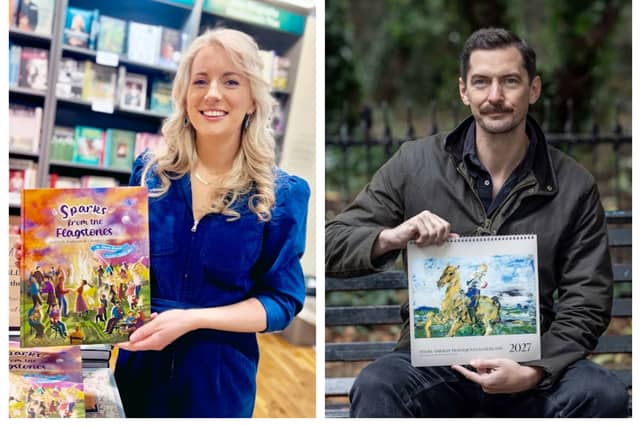

Rich Leitrim traditions will come to life as special guests Michael Steen and Edwina Guckian take listeners on a journey into the folklore of times gone by at the Leitrim Larks’ November gathering at The Dock in Carrick-on-Shannon.
“If there’s ice in November that will bear a duck, there’ll be nothing but slush and muck!” And if a goat comes to your door and lets a roar, apparently you’d better prepare for bad weather!
These were among the weather sayings gathered by pupils of Kilnagross National School in the 1930s as part of the Schools’ Folklore Collection.
There were signs to watch for in the fields, warnings about the weather, lucky and unlucky days, and any number of customs associated with the changing seasons. Some of them might still be familiar. Others, like the goat arriving at the door to announce bad weather, might be new to us!
As November settles in and the evenings grow shorter, the Leitrim Larks are taking a look at how our ancestors marked the turning of the year, with a special November “Lend an Ear” session entitled As the Year Turns on Wednesday, November 25th, in the Jury Café at The Dock, Carrick-on-Shannon.
With special guests Michael Steen and Edwina Guckian, the evening will explore the songs, stories, customs and traditions associated with the different seasons of the year.
For generations in Leitrim, the arrival of winter brought a change in the rhythm of everyday life. With the harvest work finished and the long evenings stretching ahead, there was more time to visit neighbours. The tradition of rambling, or going céilidhing, as my grandparents would have called it, was an important part of life in rural communities.
People gathered in one another’s kitchens, exchanging news, telling stories, singing songs and occasionally dancing a set or two if there was room.
There was no programme to follow and no particular pressure on anyone to perform. Some people were known for a good song or story, others were just as happy to sit and listen.
And there was always someone who could remember something that had happened years before, usually in considerable detail!
The seasons themselves provided plenty to talk about, and particular dates in the calendar came with their own customs, celebrations and warnings. Samhain, traditionally associated with the beginning of the Celtic New Year, marked the transition into winter. November Night, or Halloween, was a time of games, visiting, mischief and, according to popular belief, considerable activity among the fairies.
In a Dúchas account recorded by Annie Kelly from 79-year-old Mrs E. Kelly of Shivdillagh, we hear about the “Caitileens”, groups of boys who went from house to house on November Night, dressed in straw hats, inside-out coats, skirts and petticoats.
They brought along a character known as the Granny, who was allowed to sit down while the others stood. Her companions even checked her pulse to make sure they weren’t walking too fast for her! There was flute music, half-set dancing and singing, and sometimes the householders gave the visitors a few pennies.
Those who failed to contribute might receive the following farewell - “When you die that the skin of a goose may make a coffin for ye.”
Elsewhere, Philomena Connor of Clashaganny, Co. Roscommon, recorded how boys went out late on November Night to raid cabbage patches, scattering the cabbages along roadsides or hanging them on doors. Some householders apparently stayed up late to prevent the raids.
Meanwhile, apples were saved for Halloween games, and the old three-saucer game was used to predict whether a person would marry, emigrate or meet an early end.
The fairies were another matter altogether. Food might be left on the table for them, and throwing water outside at night was best avoided in case the passing little people happened to get wet. F. McGlynn of Rathcroghan recorded a story about a man who ignored local warnings and converted part of a fairy fort into a fowl house. On the very first night, all his fowl were eaten by rats, which, according to the account, had never been seen there before or since.
Whether you believed in the fairies or not, there were some chances perhaps not worth taking!
And it wasn’t just Halloween that came with rules! In my grandparents’ house in Kilnagross, the first person to enter on New Year’s Day had to be a dark-haired male, who would wish the household a Happy New Year and bring good luck for the months ahead. A red-haired woman was certainly not going to be allowed to cross the threshold first!
Sometimes my brother was given the job, while on other occasions my grandparents would send their own son out the back door so that he could come in through the front and deliver the necessary greeting. There was also a belief that if you spent money on New Year’s Day, you’d be spending it for the rest of the year. So the first day of January required a bit of forward planning.
And according to another old rhyme collected by many schools, including pupils in Annaduff, there were even rules about which day of the week you should get married:
Monday for health,
Tuesday for wealth,
Wednesday the best day of all,
Thursday for losses,
Friday for crosses,
And Saturday no day at all.
Thankfully, our November gathering happens to fall on a Wednesday, so if this also applies to gatherings, we’re off to a good start!
Of course, alongside the customs and superstitions were the songs that accompanied people through the year. Our special guest Michael Steen has been exploring this connection through his Féilire Amhrán Traidisiúnta na hÉireann – The Traditional Irish Song Calendar, which brings together traditional songs associated with different months, seasons and occasions.
Michael, originally from Michigan and now living in Balbriggan, Co. Dublin, is a traditional singer, multi-instrumentalist and song researcher, and a committee member of An Góilín Traditional Singers.
He’ll be sharing songs from the calendar and giving us some insight into the stories and traditions behind them.
Joining him will be well-known artist Edwina Guckian, whose work in traditional dance, folklore and cultural heritage has brought many of our older customs to new audiences.
Her book Sparks from the Flagstones explores traditions associated with different times of the year, and she’ll be sharing some of those customs and the stories behind them. Between the two, we’ll have a chance to look at the year through both its songs and its traditions, and perhaps discover a few things we didn’t know.
And that’s where the Leitrim Larks come in. In many ways, our monthly “Lend an Ear” gatherings are not so far removed from those winter evenings when neighbours called to one another’s houses for a céilí.
The setting may be different, but the idea is much the same: people getting together, sharing songs, stories and conversation, and enjoying one another’s company.
We’d love people to bring along anything they know associated with a particular time of year. It might be an old Christmas song, a harvest rhyme, a Halloween story, a poem about the seasons, or a custom that was observed in their own home or neighbourhood.
Perhaps your family had its own rules about New Year’s Day, or your grandparents could predict the weather without ever listening to a forecast!
And if you have nothing to bring, don’t let that stop you. Come along, have a listen, and enjoy the evening.
As the Year Turns, with special guests Michael Steen and Edwina Guckian, takes place on Wednesday, November 25th, from 7pm to 9pm in the Jury Café, The Dock, Carrick-on-Shannon. It is a free event supported by Leitrim County Council and Creative Ireland and all are welcome.