

Leitrim woman’s brave journey abroad for her son highlights gap in Irish prenatal care

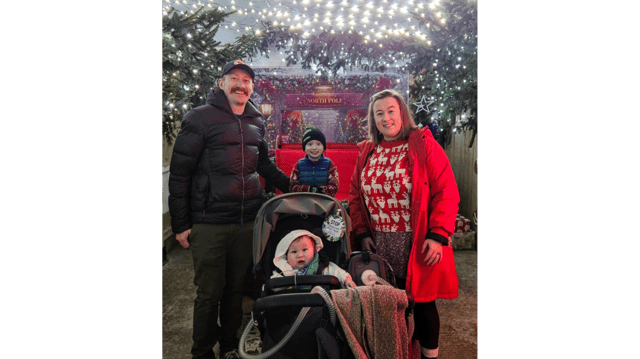

After travelling to Belgium for life-saving prenatal surgery, a Kinlough mother reflects on the toll on her family and calls for the procedure to be introduced in Ireland.
A Leitrim woman has shared her experience of travelling abroad for prenatal surgery for her son, and the toll it took on her family, as she calls for the procedure to be made available in Ireland.
Clare Lawlor-Lynch from Kinlough learned something was wrong during a routine check-up when she was 18 weeks pregnant with her son Oscar.
Clare has a history of high-risk pregnancies, having tragically lost her first child Violet, who was born prematurely due to preeclampsia. She later developed the condition again during her second pregnancy, and her son Arthur was born at 32 weeks. He is now five years old.
She recalled the moment she realised something was wrong during an appointment in Galway Hospital. “The room went quiet and I knew there was something wrong,” Clare explained.
Her consultant suspected Oscar had Congenital Diaphragmatic Hernia (CDH), a rare and serious condition where a hole in the diaphragm allows organs such as the stomach and liver to move into the chest, affecting lung development.
Having never heard of the condition, and already carrying the trauma of previous complications, Clare was overwhelmed with fear. “I didn’t know if I would stay pregnant or what that meant. You’re never prepared for something like that,” she said.
Fetoscopic Endoluminal Tracheal Occlusion (FETO) is a minimally invasive procedure used to treat CDH. It involves placing a small balloon in the baby’s trachea, trapping lung fluid to help the lungs expand and grow.
The surgery is not available in Ireland, but is offered in Belgium, leaving Clare and her husband Joe facing a difficult decision at an already distressing time.
Clare was referred to a hospital in Leuven, where she met with clinicians via video call and was informed she was a suitable candidate. “We didn’t have anything to lose by giving it a chance, and all we could do was give our baby more of a chance,” she explained.
Within a week, Clare travelled to Belgium for the procedure. While there, her main support came from family back home, as Joe remained in Ireland caring for their son Arthur, visiting whenever possible.
She said the surgery itself was straightforward and that she felt medically safe and well cared for in Leuven. However, finding accommodation proved extremely difficult. “I was terrified and I’m not a person that feels vulnerable easily. The place I finally got was like a house that was split up into apartments. I used to sleep with the chair up against the door,” she said.
The financial strain was also significant. “I had a mortgage at home and we were funding two lives with that and the rent in Leuven,” she explained.
Following the procedure, Clare was required to remain in Belgium due to the risk of her waters breaking. She spent seven weeks there, where she was able to work remotely, before the balloon was deflated and she was cleared to return to Ireland.
She went straight to the Rotunda Hospital, and after a week delivered Oscar by caesarean section at 34 weeks.
Oscar spent his first year in Dublin, where he underwent patch repair surgery, a tracheostomy and several other procedures. Now 15 months old, Clare has watched him grow and develop through it all.
“Through everything, he’s just amazing. He’s just a regular little baby,” she said, adding that she looks beyond the medical challenges he has faced. “Every decision we made was with information and for his future life in mind.”
“He has really progressed in such a short amount of time being in a home environment and having us altogether.”
On Sunday, January 25, Clare spoke at a conference in the Rotunda Hospital attended by national and international clinicians specialising in CDH, calling for FETO surgery to be made available in Ireland.
While acknowledging the deeply personal nature of the decision, Clare described how transformative it would have been for her family if the procedure had been accessible at home.
She highlighted the financial impact, explaining that she had begun saving when she became pregnant, only for those plans to be upended by travel and accommodation costs.
“On the financial side of it, it wouldn’t have been cheap to live up in Dublin if I had to stay there for FETO but it really took the buffer away,” she said.
Her family provided crucial support by caring for Arthur when Joe travelled to Belgium, but Clare said she felt isolated while abroad. “The two things you need most, safety and security, it didn’t feel like it was there,” she said.
“People make decisions whether to do FETO or not because they can or they can’t go to Belgium,” she explained. “I wonder how many kids like Oscar didn’t get the chance because their family couldn’t afford it or couldn’t leave their children at home; how many children didn’t make it although their families wanted to but couldn’t operate their lives like that.”
“It should be an option, you shouldn’t have to travel for it,” she added.